cms-part-d-prescribers · CMS
cms-part-d-prescribers · CMS
cms-part-d-prescribers · CMS
cms-part-d-prescribers · CMS
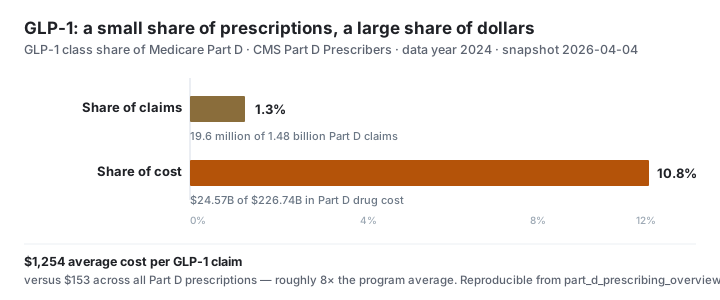
A single class of diabetes drugs has become one of the largest line items in Medicare's prescription program. In 2024, GLP-1 receptor agonists — the injectables and oral agents marketed as Ozempic, Mounjaro, Trulicity, and Rybelsus — cost Medicare Part D $24.57 billion. That is 10.8% of the program's entire $226.74 billion drug bill, spent on 19.6 million prescription claims: barely 1.3% of all Part D claims. A class that is roughly one in a hundred prescriptions now carries more than one in ten of the program's dollars.
A $24.57 billion class, almost overnight
GLP-1 drugs mimic a gut hormone that prompts insulin release and slows digestion. Approved first for type 2 diabetes, they have moved to the center of Medicare spending faster than any other therapeutic class. The 2024 federal prescribing file puts the diabetes-indicated total at $24.57 billion — money concentrated in a handful of brand-name products with no generic equivalents.
The scale is easier to grasp by comparison. The GLP-1 class costs Part D more than the entire program spends in any single U.S. state outside the four largest, and more than every prescription written by every dermatologist, urologist, and psychiatrist in the program combined. It rivals the whole of Medicare's spending on cancer drugs.
A drug class that is barely one in a hundred Part D prescriptions now accounts for more than one in ten of the program's dollars.
Four drugs are almost the entire bill
The class total hides how concentrated it is. Four brands account for 98.9% of GLP-1 spending in Part D.
| GLP-1 drug | Generic | 2024 Part D cost | Claims | Cost per claim |
|---|---|---|---|---|
| Ozempic | Semaglutide | $12.38B | 9,930,484 | $1,246 |
| Mounjaro | Tirzepatide | $5.83B | 4,694,896 | $1,241 |
| Trulicity | Dulaglutide | $4.79B | 3,816,376 | $1,254 |
| Rybelsus | Semaglutide (oral) | $1.31B | 899,704 | $1,455 |
Ozempic alone cost $12.38 billion — half the entire GLP-1 class, and enough to make it the second-costliest single drug in all of Medicare Part D, behind only the blood thinner Eliquis. Mounjaro, the newer dual-acting agent, reached $5.83 billion in 2024 on fewer than five million claims. Together, semaglutide products (Ozempic plus the oral Rybelsus) account for $13.69 billion of the class.
Why GLP-1s cost eight times the average prescription
The average Part D prescription cost the program about $153 in 2024. The average GLP-1 claim cost $1,254 — roughly eight times as much. The reason is structural rather than clinical: GLP-1 drugs are brand-only injectables still under patent, with no generic competition to pull list prices down. Most Part D prescriptions are inexpensive generics — atorvastatin, lisinopril, metformin — that cost a few dollars each. GLP-1 drugs sit at the opposite end of that distribution, and there are now enough of them to bend the whole program's cost curve.
That cost-per-claim gap is why a class with a small claim count produces an outsized bill. Volume tells you how often a drug is prescribed; cost-per-claim tells you what each prescription does to the budget. On the second measure, GLP-1 drugs are among the most consequential in Medicare.
These are gross point-of-sale costs — the total paid before manufacturer rebates. Net spending after rebates, which CMS negotiates confidentially, is lower and is not public at the drug level. The gross figures are the right basis for comparison across drugs, but they overstate what Medicare ultimately retains as cost.The drugs Medicare still won't pay for: Wegovy and Zepbound
The most widely discussed GLP-1 products — Wegovy and Zepbound, the weight-loss-labeled versions of semaglutide and tirzepatide — are almost absent from this data. Neither appears among the 50 costliest drugs in Part D for 2024.
The reason is statutory. Section 1860D-2(e)(2) of the Social Security Act excludes "agents when used for anorexia, weight loss, or weight gain" from Part D coverage. A drug approved only for chronic weight management cannot be covered by Medicare on that basis. The same molecule sold for diabetes (Ozempic, Mounjaro) is covered; sold for weight loss (Wegovy, Zepbound) it is not. Wegovy received an FDA cardiovascular-risk-reduction indication in 2024, which opens a narrow path to Part D coverage for patients with established heart disease — but in the 2024 data, weight-loss GLP-1s remain a rounding error next to their diabetes-labeled siblings.
This is the policy fault line underneath the headline number. The $24.57 billion is what Medicare spends on GLP-1 drugs under the diabetes door that is open today. Proposals to extend Part D coverage to obesity would widen that door substantially — which is why the diabetes-only figure is the right baseline to measure any future change against.
How this connects to the rest of Part D
GLP-1 spending is one thread in a larger pattern. Our Medicare Part D drug-spending overview shows the program splitting into two economies — cheap generics that carry the volume, and brand-name drugs that carry the dollars; GLP-1s are the fastest-growing corner of the brand economy. The companion study on the most expensive Medicare Part D drugs places GLP-1s against the other high-cost classes, and our prescribing-by-specialty analysis shows endocrinology and primary care — the specialties that write most GLP-1 scripts — climbing the cost table because of them. None of these studies names or surfaces any individual prescriber; all are aggregate-only.
Methodology
All figures aggregate the CMS Medicare Part D Prescribers "by Provider and Drug" public-use file for data year 2024, read from frozen materialized views over the 28.0-million-row cms_part_d_prescribers table (snapshot 2026-04-04). The GLP-1 class is defined by generic name: semaglutide, tirzepatide, dulaglutide, liraglutide, exenatide, and lixisenatide — the GLP-1 receptor agonists. Class cost and claims are the sum of total_drug_cost and total_claims over that generic set; per-brand figures come from the costliest-drugs view. Cost-per-claim is class cost divided by class claims. Shares use the program totals in the overview view. The exact queries are in the reproducibility block below and trace to the Part D Prescribers dataset. Methodology version: part-d-glp1/v1.
Limitations
- Gross cost, not net. Figures are point-of-sale drug cost before manufacturer rebates, which CMS keeps confidential at the drug level. Net Medicare spending on GLP-1s is lower than the gross totals shown.
- Diabetes indication only. Part D covers these drugs for type 2 diabetes, not weight loss. The total reflects on-label diabetes use; it is not a measure of GLP-1 use across all of U.S. healthcare.
- A single year. This is the 2024 release, the most recent full data year. It is a snapshot, not a trend line; GLP-1 spending has risen steeply year over year and will move with each refresh.
- Cost is not appropriateness. A high class total reflects price and prescribing volume, not whether any prescription was clinically warranted. This study draws no conclusion about individual prescribing decisions.
- Aggregate-only. Every figure is a drug-, class-, or program-level total. No individual prescriber is named, surfaced, or attached to any profile.
Sources
- CMS — Medicare Part D Prescribers by Provider and Drug — the federal public-use file behind every figure in this study.
- CMS — Medicare Part D Prescribers methodology — how CMS builds the prescriber-by-drug file, including the fewer-than-11-claim suppression rule.
- Social Security Act §1860D-2(e) — Excluded drugs (42 U.S.C. 1395w-102) — the statutory weight-loss exclusion that keeps Wegovy and Zepbound out of Part D.
- KFF — What to Know About Medicare Coverage of Ozempic, Wegovy, and Other GLP-1 Drugs — the diabetes-versus-weight-loss coverage distinction in policy context.
- FDA — Wegovy prescribing information (cardiovascular indication) — the 2024 cardiovascular-risk-reduction label that opens a narrow Part D coverage path.
Frequently asked questions
- How much does Medicare Part D spend on GLP-1 drugs?
- In 2024, Medicare Part D spent $24.57 billion on GLP-1 receptor agonists — the class that includes Ozempic, Mounjaro, and Trulicity. That is 10.8% of the program's entire $226.74 billion drug bill, delivered on 19.6 million prescription claims, about 1.3% of all Part D claims.
- Is Ozempic the most expensive drug in Medicare Part D?
- No — it is the second-costliest. Ozempic cost Part D $12.38 billion in 2024, behind only the blood thinner Eliquis at $19.88 billion. Ozempic alone accounts for half of all GLP-1 spending in the program and about 5.5% of total Part D drug cost.
- Does Medicare cover Ozempic and Mounjaro?
- Medicare Part D covers these drugs when prescribed for type 2 diabetes, their FDA-approved on-label use in the program. The $24.57 billion total reflects that diabetes coverage. By federal statute, Part D does not cover drugs used only for weight loss, which is why their weight-loss-labeled siblings barely appear.
- Why are GLP-1 drugs so expensive per prescription?
- GLP-1 drugs are brand-only injectables with no generic competition, so each fill carries a high list price. The average GLP-1 claim cost Part D about $1,254 in 2024 — roughly eight times the $153 average across all Part D prescriptions, which are dominated by cheap generics.
- Does Medicare cover Wegovy or Zepbound for weight loss?
- Not for weight loss alone. Section 1860D-2 of the Social Security Act excludes agents used for weight loss from Part D coverage. Neither Wegovy nor Zepbound appears among the 50 costliest Part D drugs in 2024. Wegovy gained a cardiovascular-risk indication in 2024 that can support coverage in specific cases.
- Which GLP-1 drugs drive the spending?
- Four brands carry 98.9% of the class. Ozempic ($12.38 billion) and Mounjaro ($5.83 billion) lead, followed by Trulicity ($4.79 billion) and the oral semaglutide Rybelsus ($1.31 billion). Older GLP-1 drugs such as Victoza and Byetta together make up the remaining 1.1%.
- Can I reproduce these GLP-1 spending figures?
- Yes. Every number aggregates the CMS Medicare Part D Prescribers public-use file for data year 2024, read from frozen materialized views. The GLP-1 set is defined by generic name. The exact SQL is in the reproducibility block below and traces to a specific federal snapshot dated 2026-04-04.
Datasets used
Reproducibility
Every claim, reproducible
The SQL
-- GLP-1 drugs in Medicare Part D, 2024 — fully reproducible query.
--
-- Source:   CMS Medicare Part D Prescribers, "by Provider and Drug".
-- Snapshot: cms-part-d-prescribers / data year 2024 / CMS release 2026-04-04.
-- Base:     public.cms_part_d_prescribers (~28.0M prescriber × drug rows).
-- Reads:    the five frozen materialized views created by
--           supabase/migrations/20260612150000_part_d_prescribing_research_views.sql.
--           These views aggregate the 28M-row base table ONCE (the base table is
--           too large to GROUP BY inside an 8s request), so every figure below is
--           bounded and reproducible. The GLP-1 slice is computed in the overview
--           view as a FILTER over generic_name; the per-brand rows are read from
--           the costliest-drugs view.
--
-- Every headline figure in the study resolves to one of the rows below.

-- 1. Program totals + the GLP-1 class slice (single overview row):
SELECT
  total_drug_cost,                                              -- $226,740,902,131  program total
  total_claims,                                                 -- 1,479,628,807     program claims
  glp1_cost,                                                    -- $24,567,586,107   GLP-1 class cost
  glp1_claims,                                                  -- 19,591,489        GLP-1 class claims
  round(100.0 * glp1_cost   / total_drug_cost, 2) AS glp1_cost_pct,    -- 10.84%
  round(100.0 * glp1_claims / total_claims,    2) AS glp1_claims_pct,  --  1.32%
  round(glp1_cost::numeric / glp1_claims, 2)      AS glp1_cost_per_claim,   -- $1,253.99
  round(total_drug_cost::numeric / total_claims, 2) AS program_cost_per_claim -- $153.24
FROM public.part_d_prescribing_overview_mv;

-- The GLP-1 class is defined exactly as in the view: generic_name in
--   ('Semaglutide','Tirzepatide','Dulaglutide','Liraglutide',
--    'Exenatide','Exenatide Microspheres','Lixisenatide','Semaglutide (Oral)')
-- (the GLP-1 receptor agonists), summed over data_year = 2024.

-- 2. The GLP-1 brands that surface in the 50 costliest Part D drugs:
SELECT rank, brand_name, generic_name, claims, cost,
       round(cost::numeric / claims, 2) AS cost_per_claim
FROM public.part_d_top_drugs_by_cost_mv
WHERE generic_name IN ('Semaglutide','Tirzepatide','Dulaglutide','Liraglutide',
                       'Exenatide','Exenatide Microspheres','Lixisenatide','Semaglutide (Oral)')
ORDER BY cost DESC;
--  2  Ozempic    Semaglutide        9,930,484  $12,375,986,475  $1,246  <- 2nd costliest drug overall
--  4  Mounjaro   Tirzepatide        4,694,896  $5,825,295,741   $1,241
--  7  Trulicity  Dulaglutide        3,816,376  $4,786,817,612   $1,254
-- 33  Rybelsus   Semaglutide (Oral)   899,704  $1,309,259,751   $1,455
-- The four named brands = $24,297,359,579 = 98.9% of the $24.57B class total;
-- the remaining 1.1% is older GLP-1s (Victoza, Byetta, etc.) below the top 50.

-- 3. Wegovy / Zepbound absence check — neither appears in the 50 costliest drugs
--    (Part D excludes weight-loss-only agents per SSA §1860D-2(e)(2)):
SELECT count(*) AS weight_loss_glp1_in_top50
FROM public.part_d_top_drugs_by_cost_mv
WHERE brand_name IN ('Wegovy','Zepbound');     -- 0
The snapshot
| dataset_id | cms-part-d-prescribers |
| snapshot_date | 2026-04-04 |
| sha256 | |
| doi | 10.5072/fonteum/medicare-part-d-glp1-spending-2026 |
| slsa_provenance_url |
The JOINs
glp1_cost   = sum(total_drug_cost) where generic_name in (Semaglutide, Tirzepatide, Dulaglutide, Liraglutide, Exenatide, Lixisenatide)  -- $24,567,586,107
glp1_claims = sum(total_claims) over the same GLP-1 generic set                                                                          -- 19,591,489
program_cost   = part_d_prescribing_overview_mv.total_drug_cost   -- $226,740,902,131
glp1_cost_share = glp1_cost / program_cost                        -- 10.84%
glp1_cost_per_claim = glp1_cost / glp1_claims                     -- $1,253.99
The pipeline version
| git_sha | |
| slsa_provenance | |
| methodology_version | part-d-glp1/v1 |
Reproduce this
Run the exact query against the frozen 2026-04-04.
Cite this study
Citation-ready for researchers and AI.
Check the chain
Each figure is snapshot-attested — re-derive the hash from the federal file.
cms-part-d-prescribers · 2026-04-04SHA-256 a3f1c9…7e6b- FINANCIAL DISTRESS · JUN 2026The most expensive Medicare Part D drugs are rarely the most prescribedEliquis cost Medicare Part D $19.88 billion in 2024 — the single costliest drug in the program, yet only its 12th most-prescribed. That inversion defines Part D: brand-name drugs are 23.9% of prescriptions but 90.1% of the dollars, while cheap generics carry the volume and almost none of the cost.
- WORKFORCE · JUN 2026Who prescribes Medicare's drug spending? Nurse practitioners now leadNurse practitioners drove $37.48 billion of Medicare Part D drug cost in 2024 — more than any other specialty, including internal medicine and cardiology. But the steepest bills come from oncology: hematology-oncologists averaged $2,441 per prescription, sixteen times the program-wide $153, on a fraction of the claims.
- ACCESS · JUN 2026Medicare Part D drug spending by state: where the dollars concentrateCalifornia prescribers drove $21.26 billion of Medicare Part D drug cost in 2024, the most of any state — followed by New York at $18.17 billion, Florida ($16.84 billion), and Texas ($15.75 billion). The four largest states alone account for nearly a third of the program's $226.74 billion in drug spending.
- WORKFORCE · JUN 2026Who is enrolled in Medicare? The nurse practitioner is now the most common clinician413,539 nurse practitioner enrollments make NPs the single most common clinician type in Medicare's provider-enrollment file — 13.9% of all 2.98 million PECOS records, nearly triple the largest physician specialty. Together, NPs and physician assistants are one in five enrollments. Advanced-practice providers now anchor the Medicare workforce.
- ACCESS · APR 2026A March spike in Medicare enrollment deactivations thinned provider supply in shortage areasMedicare enrollment deactivations in PECOS ran 28% above the trailing-twelve-month average in March 2026 — and the spike was not uniform. Deactivations in HRSA-designated shortage areas grew 41% against trend, versus 19% elsewhere. The places least able to absorb a departure lost providers fastest.
Federal source citations
Fonteum Research · June 12, 2026 · All figures trace to the frozen federal-data snapshot cited above.