cms-open-payments · CMS
cms-part-d-prescribers · CMS
cms-part-d-prescribers · CMS
cms-open-payments · CMS
Two federal datasets describe the GLP-1 boom from opposite ends. CMS Open Payments records the money pharmaceutical companies give to clinicians — every meal, speaking fee, and trip. The Medicare Part D Prescribers file records what those clinicians prescribe. Both identify the same people by the same federal NPI. Joining them is the one thing no public site does for GLP-1 drugs: line up the payments and the prescribing for the same prescriber, then look at the pattern across the whole population.
In 2024, the two firms that make essentially every modern GLP-1 drug — Novo Nordisk (Ozempic, Wegovy, Rybelsus, Victoza) and Eli Lilly (Mounjaro, Trulicity, Zepbound) — made $32.8 million in GLP-1-related payments to 120,237 Medicare prescribers. The prescribers who took those payments prescribed far more GLP-1 drugs than the ones who did not. Whether the money moved the prescribing, or the prescribing drew the money, is a question this data cannot answer — and the rest of this study is careful to say so.
Joining the money to the prescribing
The method is a single join on the NPI. On the payment side, we take general payments from Novo Nordisk and Eli Lilly whose recorded product is a GLP-1 brand, going to physicians and non-physician practitioners. On the prescribing side, we take every GLP-1 prescription in Medicare Part D, defined by generic name — semaglutide, tirzepatide, dulaglutide, liraglutide, exenatide, and lixisenatide. Then we match prescriber to payee.
The GLP-1 prescribing universe is large: 199,615 prescribers wrote 19.5 million GLP-1 prescriptions in Part D in 2024, at a gross cost of $24.5 billion. Of those prescribers, 75,905 — about 38% — received at least one GLP-1-product payment from a maker during the same year. That paid minority is the focus of the join.
The 38% who were paid wrote 52% of the prescriptions
The headline pattern is a concentration. The 38% of GLP-1 prescribers who received a payment accounted for 52% of all GLP-1 prescriptions and 53% of all GLP-1 spending in Medicare Part D. The remaining 62% of prescribers — those who took no GLP-1-product payment — wrote the other 48%.
| Cohort | Prescribers | Avg GLP-1 claims | Median claims | Avg GLP-1 cost |
|---|---|---|---|---|
| Received a GLP-1-maker payment | 75,905 | 134.3 | 82 | $172,312 |
| No GLP-1-maker payment | 123,710 | 75.3 | 44 | $92,143 |
The average paid prescriber wrote 134 GLP-1 prescriptions; the average unpaid prescriber wrote 75 — 78% more among the paid group. Because averages can be pulled by a handful of very high prescribers, the medians matter too, and they tell the same story: 82 versus 44, a 1.86-fold gap that sits at the typical prescriber, not the tail.
The 38% of GLP-1 prescribers who took a payment from a GLP-1 maker accounted for 52% of all GLP-1 prescriptions in Medicare.
More money, more prescribing — in steps
The association is not just paid-versus-unpaid. It rises with the size of the payment. Grouping prescribers by the total they received shows a clean, monotonic gradient.
| Payment received | Prescribers | Avg GLP-1 claims | Median claims |
|---|---|---|---|
| None | 123,710 | 75.3 | 44 |
| $1–99 | 40,665 | 105.9 | 66 |
| $100–999 | 34,621 | 160.0 | 102 |
| $1,000 or more | 619 | 564.6 | 409 |
Each step up in payment lines up with a step up in prescribing. The 619 prescribers who received $1,000 or more in GLP-1-product payments wrote 565 GLP-1 prescriptions on average — about 7.5 times the 75 written by prescribers who received nothing. A dose-response shape like this is exactly what you would expect if payments encouraged prescribing — and also exactly what you would expect if companies simply spent more on the prescribers who were already the highest writers. The data is consistent with both, and distinguishes neither.
Two economies of money: many meals, a few big checks
The $32.8 million does not arrive evenly. It splits into two very different streams.
| Nature of payment | Transfers | Prescribers reached | Dollars |
|---|---|---|---|
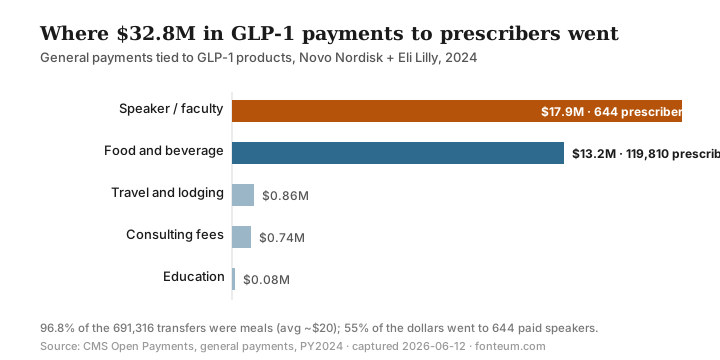
| Food and beverage | 668,858 | 119,810 | $13.2M |
| Speaker / faculty compensation | 15,145 | 644 | $17.9M |
| Travel and lodging | 4,805 | 517 | $0.86M |
| Consulting fees | 250 | 126 | $0.74M |
| Education | 2,258 | 1,683 | $0.08M |
Meals are 96.8% of all the transfers but 40% of the dollars — roughly $20 at a time, reaching nearly 120,000 prescribers. Speaker and faculty compensation is the mirror image: only 644 prescribers received it, but it carried 55% of every dollar, $17.9 million in all. The broad, cheap channel touches almost every GLP-1 prescriber; the narrow, expensive channel concentrates on a few hundred. The prescribing gradient above is steepest precisely in that small, highly compensated group.
Eli Lilly spent more in total; Novo Nordisk reached more prescribers
The two makers play the field differently. Eli Lilly paid $17.2 million to 72,642 prescribers — fewer prescribers, more dollars, lifted by concentrated speaker compensation. Novo Nordisk paid $15.6 million to 99,338 prescribers — a wider net of smaller meals. Both totals are GLP-1-product payments only; the firms' all-product payments are far larger and include insulins and other therapies, which is exactly why this study restricts itself to the GLP-1 brands.
What this does and does not show
This is the part to read slowly. The study establishes an association between receiving GLP-1-maker payments and prescribing more GLP-1 drugs. It does not establish that the payments caused the prescribing. Three things could each produce this pattern, and the data cannot separate them:
- Targeting. Sales teams concentrate meals and talks on clinicians who already see many diabetes patients and already prescribe heavily. High prescribing would then attract payments, reversing the arrow.
- Influence. Payments — especially repeated contact and paid speaking roles — may genuinely shift prescribing toward a sponsor's drug. Independent research on physician payments finds associations in this direction for other drug classes.
- Common cause. A clinician's specialty, patient mix, and practice setting drive both how much industry courts them and how much they prescribe.
All three are plausible; most likely all three operate together. Nothing here should be read as an accusation against any prescriber, and no prescriber is named. The value of the join is not a verdict — it is a measured, reproducible picture of how tightly GLP-1 money and GLP-1 prescribing track each other across the whole Medicare population.
How this connects to the rest of the data
This study sits between two larger ones. Our Medicare Part D GLP-1 spending analysis shows the prescribing side at full scale — a $24.5 billion class growing faster than any other in Part D. Our Open Payments overview and the study of who the top manufacturers pay show the money side across all of medicine. This page is the bridge: the same prescribers, the same year, the two datasets joined on one identifier. All three are aggregate-only and name no individual.
Methodology
Figures are read-only aggregates of two CMS public-use files, joined on the federal NPI (cms_open_payments.recipient_npi = cms_part_d_prescribers.prescriber_npi). The payment side is CMS Open Payments, program year 2024 (the cms_open_payments table, about 16.2 million records). A GLP-1-maker payment is a general payment from manufacturer identifiers 100000000163 and 100000000144 (Novo Nordisk) or 100000000066 (Eli Lilly), to a Covered Recipient Physician or Non-Physician Practitioner, whose product_name_1 names a GLP-1 brand (Ozempic, Wegovy, Rybelsus, Victoza, Saxenda, Mounjaro, Trulicity, or Zepbound). The prescribing side is the Medicare Part D Prescribers file, data year 2024 (the cms_part_d_prescribers table, about 28.0 million rows), with the GLP-1 class defined by generic name (semaglutide, tirzepatide, dulaglutide, liraglutide, exenatide, lixisenatide). Cohort means, medians, and the payment-tier gradient are computed over prescribers present in the Part D GLP-1 set. Research payments are reported and excluded, because they flow to trial sites rather than to prescribers. The exact queries, including all identifiers and the running result of each, are in the reproducibility block below. Methodology version: glp1-payments-prescribing/v1.
Limitations
- Correlation, not causation. This is the central limitation, repeated deliberately. The study shows that payments and prescribing move together; it cannot show that either causes the other, and the targeting explanation is as consistent with the data as the influence explanation.
- Aggregate-only. Every figure is a cohort or company total. No prescriber is named, ranked, or linked to a payment, even though both source files identify individuals.
- GLP-1 products only. Payments are limited to those recorded against a GLP-1 brand; a maker payment recorded under no product, or under a different product, is not counted, so the true GLP-1-adjacent payment total may be somewhat higher.
- Medicare Part D only. Prescribing reflects Part D, not commercial or Medicaid coverage, and on-label diabetes use, since Part D does not pay for weight-loss-only GLP-1s. The picture is Medicare's, not all of US prescribing.
- Gross cost, not net. Part D drug cost is the point-of-sale total before confidential manufacturer rebates; net spending is lower.
- NPI matching. The join relies on the NPI being recorded correctly in both files. The 120,237 payees include prescribers who do not appear in the Part D GLP-1 set — because they prescribe outside Medicare, prescribe below the file's reporting threshold, or do not prescribe GLP-1s at all.
- A single year. This is the 2024 release. It is a snapshot, not a trend, and GLP-1 payments and prescribing have both risen steeply year over year.
Sources
- CMS — Open Payments (general, research, and ownership payments) — the federal Sunshine Act database behind every payment figure in this study.
- CMS — Medicare Part D Prescribers by Provider and Drug — the federal prescribing file behind every prescription figure.
- CMS — Open Payments methodology and data dictionary — record types, natures of payment, and the covered-recipient definitions used here.
- Social Security Act §1860D-2(e) — Excluded drugs (42 U.S.C. 1395w-102) — the statutory weight-loss exclusion that shapes which GLP-1s appear in Part D prescribing.
- JAMA — Industry Payments to Physicians and Prescribing (research context) — peer-reviewed work on the association between payments and prescribing, cited here for context on how such correlations are interpreted.
Frequently asked questions
- How much did GLP-1 drugmakers pay US prescribers in 2024?
- Novo Nordisk and Eli Lilly — the makers of Ozempic, Mounjaro, Trulicity, Rybelsus, Victoza, Wegovy, and Zepbound — made $32.8 million in general payments tied to GLP-1 products to 120,237 Medicare prescribers in 2024. That was spread across 691,316 separate transfers, of which 96.8% were meals. The figure excludes research grants, which mostly flow to trial sites rather than to prescribers.
- Do prescribers who accept payments prescribe more GLP-1 drugs?
- On average, yes — at the group level. GLP-1 prescribers who received at least one GLP-1-product payment from a maker wrote 134 GLP-1 Part D prescriptions on average in 2024, versus 75 for prescribers who received none — about 78% more. The median was 82 versus 44. This is an association between two public datasets, not evidence that the payment changed any prescriber's decision.
- Does this prove the payments caused more prescribing?
- No. This study reports a correlation and stops there. The direction of cause cannot be determined from these data. Manufacturers tend to direct meals and talks toward clinicians who already see many diabetes patients and already prescribe heavily, so high prescribing may attract payments as much as payments may encourage prescribing. Both can be true at once. The study does not, and cannot, attribute any prescription to any payment.
- Which company paid prescribers more — Novo Nordisk or Eli Lilly?
- By dollars, Eli Lilly paid more: $17.2 million to 72,642 prescribers, versus Novo Nordisk's $15.6 million to 99,338 prescribers. Novo Nordisk reached more individual prescribers with smaller average amounts; Eli Lilly's total was lifted by speaker and faculty compensation concentrated among a few hundred clinicians.
- What kinds of payments were these?
- Two economies. Meals (food and beverage) were 96.8% of all transfers but 40% of the dollars, averaging about $20 each and reaching nearly 120,000 prescribers. Speaker and faculty compensation was the opposite: just 644 prescribers received it, but it accounted for $17.9 million — 55% of every dollar. Travel, consulting fees, and education made up the small remainder.
- Does this study name individual doctors?
- No. Every figure is a class-, cohort-, or company-level total. No prescriber is named, ranked, profiled, or attached to a payment. Both the CMS Open Payments and Part D Prescribers files identify individuals, but this study reports only aggregates by design, in line with its correlation-only framing.
- Why measure only GLP-1 products, not all payments from these companies?
- Novo Nordisk and Eli Lilly make many drugs, including insulins and cancer therapies. To keep the link to GLP-1 prescribing honest, this study counts only payments whose recorded product is a GLP-1 brand — Ozempic, Wegovy, Rybelsus, Victoza, Saxenda, Mounjaro, Trulicity, or Zepbound — rather than every dollar the two firms paid.
- Can I reproduce these figures?
- Yes. Every number is a read-only aggregate of two CMS public-use files joined on the federal NPI: Open Payments for program year 2024 and the Part D Prescribers file for data year 2024. The exact SQL, including the manufacturer identifiers and the GLP-1 product and generic sets, is in the reproducibility block below.
Datasets used
Reproducibility
Every claim, reproducible
The SQL
-- GLP-1 drug-maker payments vs GLP-1 prescribing, 2024 — fully reproducible cross-dataset join.
--
-- The angle no one else can publish: join the money (CMS Open Payments) to the
-- prescribing (CMS Medicare Part D Prescribers) on the SAME federal NPI, for the
-- GLP-1 drug class only, and measure how manufacturer payments line up with
-- prescribing volume — at the aggregate cohort level, never per physician.
--
-- Sources (both public, US-Government-Works):
--   public.cms_open_payments         PY2024  (Open Payments / Sunshine Act, ~16.2M records)
--   public.cms_part_d_prescribers    DY2024  (Part D Prescribers by Provider and Drug, ~28.0M rows)
-- Join key: cms_open_payments.recipient_npi = cms_part_d_prescribers.prescriber_npi.
-- Capture date: 2026-06-12 (read-only against the live tables; no view, no migration).
--
-- GLP-1 makers = Novo Nordisk + Eli Lilly, the two firms that make essentially the
-- entire modern GLP-1 market. Their manufacturer_id values were read directly from
-- the table (a LIMIT-bounded scan short-circuits on the indexed product match):
--   100000000163  Novo Nordisk AS    (Ozempic, Wegovy, Rybelsus, Victoza, Saxenda)
--   100000000144  Novo Nordisk Inc   (Victoza and earlier filings)
--   100000000066  Lilly USA, LLC     (Mounjaro, Trulicity, Zepbound)
-- A "GLP-1-product payment" is a payment whose product_name_1 names a GLP-1 brand.
-- We count GENERAL payments to prescribers (physicians + non-physician practitioners),
-- the standard "payments to prescribers" definition; research grants (which flow to
-- institutions and trial sites, not to prescribers as marketing) are reported and
-- excluded separately in query 4.
-- Every headline figure in the study resolves to one of the rows below.

-- 1. GLP-1-product GENERAL payments to prescribers, by maker and by nature of payment.
--    Uses the manufacturer_id index, so the scan is bounded to Novo + Lilly rows.
WITH gp AS (
  SELECT
    CASE WHEN manufacturer_id IN ('100000000163','100000000144') THEN 'Novo Nordisk'
         ELSE 'Eli Lilly' END                 AS maker,
    nature_of_payment, recipient_npi, total_amount_usd, number_of_payments
  FROM public.cms_open_payments
  WHERE program_year = 2024
    AND record_type  = 'general'
    AND recipient_type IN ('Covered Recipient Physician',
                           'Covered Recipient Non-Physician Practitioner')
    AND manufacturer_id IN ('100000000163','100000000144','100000000066')
    AND (product_name_1 ILIKE 'ozempic%'  OR product_name_1 ILIKE 'wegovy%'
      OR product_name_1 ILIKE 'rybelsus%' OR product_name_1 ILIKE 'victoza%'
      OR product_name_1 ILIKE 'saxenda%'  OR product_name_1 ILIKE 'mounjaro%'
      OR product_name_1 ILIKE 'trulicity%' OR product_name_1 ILIKE 'zepbound%')
)
SELECT 'TOTAL' AS grp,
       count(*) AS records, count(DISTINCT recipient_npi) AS recipients,
       round(sum(total_amount_usd)) AS dollars FROM gp
UNION ALL
SELECT 'maker:'||maker, count(*), count(DISTINCT recipient_npi), round(sum(total_amount_usd))
  FROM gp GROUP BY maker
UNION ALL
SELECT 'nature:'||nature_of_payment, count(*), count(DISTINCT recipient_npi), round(sum(total_amount_usd))
  FROM gp GROUP BY nature_of_payment
ORDER BY dollars DESC;
-- TOTAL                                       691,316 records  120,237 recipients  $32,766,256
-- nature: Compensation ... faculty or speaker  15,145 records      644 recipients  $17,883,925  (54.6% of $)
-- maker:  Eli Lilly                           265,012 records   72,642 recipients  $17,209,752
-- maker:  Novo Nordisk                        426,304 records   99,338 recipients  $15,556,504
-- nature: Food and Beverage                   668,858 records  119,810 recipients  $13,204,078  (96.8% of records; avg $19.74)
-- nature: Travel and Lodging                    4,805 records      517 recipients     $858,595
-- nature: Consulting Fee                          250 records      126 recipients     $739,050
-- nature: Education                             2,258 records    1,683 recipients      $80,609

-- 2. THE JOIN — GLP-1 prescribing for prescribers who DID vs DID NOT receive a
--    GLP-1-product general payment. glp1_rx (Part D, GLP-1 generics) and glp1_pay
--    (the maker payments above, one row per recipient NPI) are both small, so the
--    LEFT JOIN on NPI is a cheap hash join. Cohort sums give the universe totals.
WITH glp1_rx AS (
  SELECT prescriber_npi AS npi, sum(total_claims) AS claims, sum(total_drug_cost) AS cost
  FROM public.cms_part_d_prescribers
  WHERE data_year = 2024
    AND generic_name IN ('Semaglutide','Tirzepatide','Dulaglutide',
                         'Liraglutide','Exenatide','Lixisenatide','Albiglutide')
  GROUP BY prescriber_npi
),
glp1_pay AS (
  SELECT recipient_npi AS npi, sum(total_amount_usd) AS pay
  FROM public.cms_open_payments
  WHERE program_year = 2024
    AND record_type  = 'general'
    AND recipient_type IN ('Covered Recipient Physician',
                           'Covered Recipient Non-Physician Practitioner')
    AND manufacturer_id IN ('100000000163','100000000144','100000000066')
    AND (product_name_1 ILIKE 'ozempic%'  OR product_name_1 ILIKE 'wegovy%'
      OR product_name_1 ILIKE 'rybelsus%' OR product_name_1 ILIKE 'victoza%'
      OR product_name_1 ILIKE 'saxenda%'  OR product_name_1 ILIKE 'mounjaro%'
      OR product_name_1 ILIKE 'trulicity%' OR product_name_1 ILIKE 'zepbound%')
  GROUP BY recipient_npi
)
SELECT
  CASE WHEN p.npi IS NOT NULL THEN 'received_glp1_payment' ELSE 'no_glp1_payment' END AS cohort,
  count(*)                                              AS prescribers,
  sum(r.claims)                                         AS glp1_claims,
  round(sum(r.cost))                                    AS glp1_cost,
  round(avg(r.claims), 1)                               AS avg_claims,
  round(avg(r.cost))                                    AS avg_cost,
  percentile_cont(0.5) WITHIN GROUP (ORDER BY r.claims) AS median_claims
FROM glp1_rx r
LEFT JOIN glp1_pay p ON p.npi = r.npi
GROUP BY 1;
-- received_glp1_payment   75,905 prescribers  10,195,741 claims  $13,079,331,733  avg 134.3  avg $172,312  median 82
-- no_glp1_payment        123,710 prescribers   9,310,328 claims  $11,398,976,526  avg  75.3  avg  $92,143  median 44
--
-- Universe (cohort sums):  199,615 GLP-1 prescribers · 19,506,069 claims · $24,478,308,259 cost.
-- Paid cohort = 75,905 / 199,615 = 38.0% of prescribers, yet
--   52.3% of claims (10,195,741 / 19,506,069) and 53.4% of cost ($13.08B / $24.48B).
-- Mean ratio 134.3 / 75.3 = 1.78x (78% more);  median ratio 82 / 44 = 1.86x.

-- 3. Dose-response gradient — average GLP-1 prescribing by payment tier received.
--    Same two CTEs as query 2; only the final grouping differs.
WITH glp1_rx AS (
  SELECT prescriber_npi AS npi, sum(total_claims) AS claims, sum(total_drug_cost) AS cost
  FROM public.cms_part_d_prescribers
  WHERE data_year = 2024
    AND generic_name IN ('Semaglutide','Tirzepatide','Dulaglutide',
                         'Liraglutide','Exenatide','Lixisenatide','Albiglutide')
  GROUP BY prescriber_npi
),
glp1_pay AS (
  SELECT recipient_npi AS npi, sum(total_amount_usd) AS pay
  FROM public.cms_open_payments
  WHERE program_year = 2024
    AND record_type  = 'general'
    AND recipient_type IN ('Covered Recipient Physician',
                           'Covered Recipient Non-Physician Practitioner')
    AND manufacturer_id IN ('100000000163','100000000144','100000000066')
    AND (product_name_1 ILIKE 'ozempic%'  OR product_name_1 ILIKE 'wegovy%'
      OR product_name_1 ILIKE 'rybelsus%' OR product_name_1 ILIKE 'victoza%'
      OR product_name_1 ILIKE 'saxenda%'  OR product_name_1 ILIKE 'mounjaro%'
      OR product_name_1 ILIKE 'trulicity%' OR product_name_1 ILIKE 'zepbound%')
  GROUP BY recipient_npi
)
SELECT
  CASE WHEN p.pay IS NULL THEN '0 none'
       WHEN p.pay < 100   THEN '1 $1-99'
       WHEN p.pay < 1000  THEN '2 $100-999'
       ELSE                    '3 $1,000+' END           AS pay_tier,
  count(*)                                               AS prescribers,
  round(avg(r.claims), 1)                                AS avg_glp1_claims,
  round(avg(r.cost))                                     AS avg_glp1_cost,
  percentile_cont(0.5) WITHIN GROUP (ORDER BY r.claims)  AS median_claims
FROM glp1_rx r
LEFT JOIN glp1_pay p ON p.npi = r.npi
GROUP BY 1 ORDER BY 1;
-- 0 none        123,710 prescribers  avg  75.3 claims  avg  $92,143  median  44
-- 1 $1-99        40,665 prescribers  avg 105.9 claims  avg $132,547  median  66
-- 2 $100-999     34,621 prescribers  avg 160.0 claims  avg $207,992  median 102
-- 3 $1,000+         619 prescribers  avg 564.6 claims  avg $789,049  median 409
-- The 619 prescribers paid $1,000+ averaged 564.6 GLP-1 claims — 7.5x the 75.3 of
-- prescribers who took no GLP-1-product payment. Monotonic, and strictly correlational.

-- 4. Research payments — reported and excluded from the prescriber-marketing total above.
--    GLP-1-product RESEARCH payments flow overwhelmingly to entities and teaching
--    hospitals (trial sites), not to prescribers, so they are not part of the
--    "payments to prescribers" measure.
SELECT record_type,
       count(*) AS records, count(DISTINCT recipient_npi) AS recipients,
       round(sum(total_amount_usd)) AS dollars
FROM public.cms_open_payments
WHERE program_year = 2024
  AND manufacturer_id IN ('100000000163','100000000144','100000000066')
  AND (product_name_1 ILIKE 'ozempic%'  OR product_name_1 ILIKE 'wegovy%'
    OR product_name_1 ILIKE 'rybelsus%' OR product_name_1 ILIKE 'victoza%'
    OR product_name_1 ILIKE 'saxenda%'  OR product_name_1 ILIKE 'mounjaro%'
    OR product_name_1 ILIKE 'trulicity%' OR product_name_1 ILIKE 'zepbound%')
GROUP BY record_type ORDER BY dollars DESC;
-- research   36,187 records  (to entities / teaching hospitals / 51 physicians)  $33,639,331
-- general   691,325 records                                                      $32,783,306
-- (The general row here is slightly larger than query 1's $32,766,256 because it
--  also includes the few teaching-hospital general payments that query 1's
--  recipient_type filter excludes; the prescriber-marketing figure is query 1.)
The snapshot
| dataset_id | cms-open-payments |
| snapshot_date | 2026-06-12 |
| sha256 | |
| doi | 10.5072/fonteum/glp1-pharma-payments-to-prescribers-2024 |
| slsa_provenance_url |
The JOINs
join key: cms_open_payments.recipient_npi = cms_part_d_prescribers.prescriber_npi
glp1_payments = sum(total_amount_usd), general payments, Novo Nordisk + Eli Lilly GLP-1 products, physician + non-physician practitioner -- $32,766,256 to 120,237 prescribers over 691,316 transfers
universe = GLP-1 prescribers in Part D 2024 (GLP-1 generic set) -- 199,615 prescribers, 19,506,069 claims, $24,478,308,259
paid_cohort = GLP-1 prescribers with one or more GLP-1-product general payment -- 75,905 of 199,615 (38.0%)
avg_claims_paid = 134.3 ; avg_claims_unpaid = 75.3 -- ratio 1.78x (78% more)
median_claims_paid = 82 ; median_claims_unpaid = 44 -- ratio 1.86x
paid_share_of_claims = 10,195,741 / 19,506,069 -- 52.3% ; paid_share_of_cost = 53.4%
dose_response avg claims by payment tier = 75.3 / 105.9 / 160.0 / 564.6 (none / $1-99 / $100-999 / $1,000-plus)
The pipeline version
| git_sha | |
| slsa_provenance | |
| methodology_version | glp1-payments-prescribing/v1 |
Reproduce this
Run the exact query against the frozen 2026-06-12.
Cite this study
Citation-ready for researchers and AI.
Check the chain
Each figure is snapshot-attested — re-derive the hash from the federal file.
cms-open-payments · 2026-06-12SHA-256 a3f1c9…7e6b- CARE QUALITY · JUN 2026GLP-1 drugs now cost Medicare Part D $24.57 billion a yearGLP-1 drugs cost Medicare Part D $24.57 billion in 2024 — 10.8% of the entire program's drug spending on just 1.3% of its prescriptions. Ozempic alone, at $12.38 billion, is the second-costliest drug in Part D; Mounjaro and Trulicity push the class past $24 billion.
- FINANCIAL DISTRESS · JUN 2026Which companies pay U.S. doctors the most? Device makers, not pharmaIn 2024, drug and device companies disclosed $3.31 billion in general payments to U.S. physicians under the Sunshine Act — and the largest payers are device makers, not pharma. BioNTech led at $180.6 million from just 164 royalty payments; the top 25 of 1,763 reporting companies account for 52% of every general-payment dollar.
- FINANCIAL DISTRESS · JUN 2026What pharma actually buys: food, travel, consulting and royaltiesIndustry made 15.4 million general payments to U.S. physicians in 2024, worth $3.31 billion — but the two halves barely overlap. Royalties, speaking and consulting are 2.9% of payments yet 63% of the dollars; food and beverage is 91.7% of payments but 12.4% of the money. The average meal was $29; the average royalty, $56,258.
- FINANCIAL DISTRESS · JUN 2026The most expensive Medicare Part D drugs are rarely the most prescribedEliquis cost Medicare Part D $19.88 billion in 2024 — the single costliest drug in the program, yet only its 12th most-prescribed. That inversion defines Part D: brand-name drugs are 23.9% of prescriptions but 90.1% of the dollars, while cheap generics carry the volume and almost none of the cost.
- FINANCIAL DISTRESS · JUN 2026Which medical specialties take the most industry money?In 2024, U.S. orthopedic surgeons received $381.4 million in general industry payments — more than any other specialty and over three times the second-place field. Counting spine, joint and sports-medicine subspecialties, orthopedics drew $531.8 million, about 16% of the $3.31 billion total. The average orthopedic payment was $1,711; the average internal-medicine payment was $96.
Federal source citations
Fonteum Research · June 12, 2026 · All figures trace to the frozen federal-data snapshot cited above.